
What if your lecture notes or textbooks could turn themselves into flashcards and quizzes—tailored to your learning style—with one click? NotebookLM now lets learners do just that. With its new flashcards & quizzes features, NotebookLM emerges as a powerful AI study tool for students, teachers, and anyone keen on learning efficiently.
In this post you’ll discover:
- What NotebookLM Flashcards & Quizzes are and how they work
- How it stacks up against Anki, Quizlet, and other AI helpers
- A real-use case for students & lifelong learners
- The broader trend: AI as your personalized tutor
What Are NotebookLM Flashcards & Quizzes?
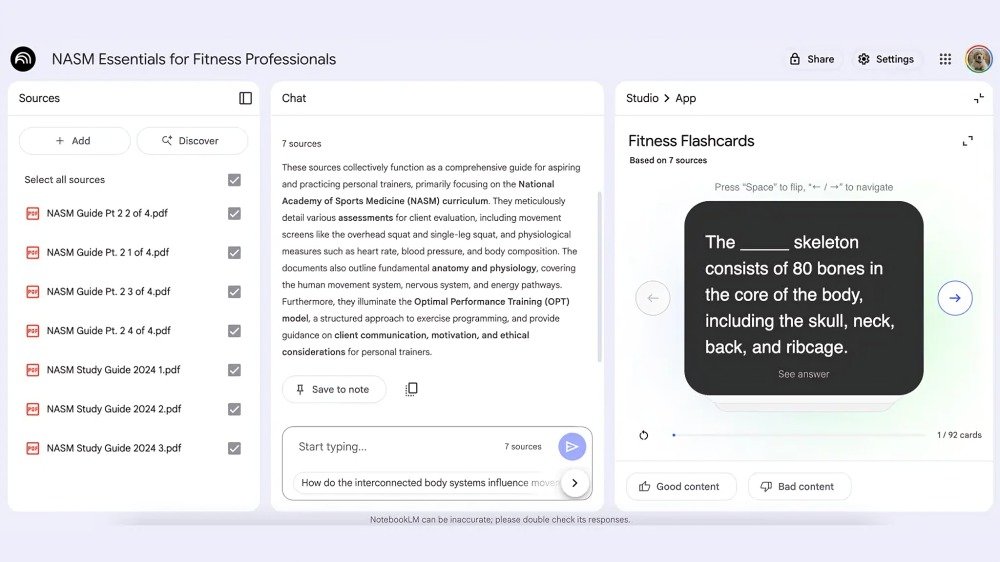
NotebookLM recently rolled out these features: flashcards and quizzes that auto-generate from your notes, documents, or other sources.
Key features include:
- Convert uploaded notes, PDFs, or lecture text into flashcards covering key terms, core concepts, or dates.
- Quizzes that test comprehension, with adjustable difficulty levels (Easy, Medium, Hard).
- “Explain” option: if you get a quiz question wrong or want more context, NotebookLM provides explanations with citations.
- Customization: you can set number of flashcards/questions, and focus topics.
Real-Use Case: How a Student Might Use It
Here’s a scenario:
- Upload your materials — lecture slides or PDF readings into NotebookLM.
- Generate flashcards on the core concepts: definitions, key ideas, dates, formulas.
- Create a quiz to test understanding, selecting “Medium” difficulty and specific topic areas.
- Review wrong answers using the “explain” button to understand why something was incorrect.
- Iterate & share: tweak the quiz or flashcard set, share with classmates or study group.
This saves hours manually writing cards or creating tests, lets you focus on understanding rather than note transcription.
Comparing NotebookLM vs Anki & Quizlet
| Tool | Strengths | Weaknesses / Limitations |
|---|---|---|
| NotebookLM | Auto-generate from uploaded notes; explanations + source citation; customizable difficulty; integrated AI tutor-style help. | New features so may have bugs; less mature in large communities / premade decks; may require good input sources. |
| Anki | Very strong spaced repetition system; huge user base; customization; many card formats (cloze, images, audio etc.). | Steeper learning curve; manual setup needed; less AI-assisted generation out of the box. |
| Quizlet | User friendly; gamified tools; many premade sets; collaborative study; recently added adaptive learning features and AI tools. | Some features locked behind paywalls; less fine control; not always strong on long-term retention scheduling. |
The Bigger Trend: AI as Personalized Tutor
- AI tools are moving from passive helpers (just answering prompts) to active learning companions that adapt to your needs. NotebookLM now includes features like quizzes, explanations, and guidance.
- Other examples: ChatGPT’s Study Mode that forces deeper engagement rather than just giving answers.
- In education research, tools like NeuroChat explore adapting content dynamically based on student engagement signals.
- Personalized tutors position AI to support diverse learning styles, pacing, background, and gaps in knowledge.
Limitations & Things to Watch
- Dependence on input quality: If your notes are poor, flashcards / quizzes may misrepresent or miss important details.
- Over-reliance on AI explanations can reduce your own effort in understanding or critical thinking.
- Accuracy & bias: AI might generate incorrect answers or misinterpret nuances. Always cross-check.
- Spaced repetition and retention: While NotebookLM now has flashcards/quizzes, it may not yet match Anki’s proven models for long-term memory unless paired with other tools.
Summary / Takeaways
- NotebookLM’s flashcards & quizzes introduce powerful study features: auto generation, explanations, difficulty control.
- These tools offer major time savings, especially for students dealing with large volumes of content.
- In comparing with Anki & Quizlet, you can see trade-offs: more automation vs more control.
- The broader movement: AI is becoming more like a personal tutor—proactive, adaptive, explanatory.
Conclusion
NotebookLM Flashcards & Quizzes mark a meaningful step toward smarter, AI-assisted studying. For students and lifelong learners, these features offer efficiency, clarity, and understanding—if used well and critically.
Sources
Sources for this post include 9to5Google, TechLearning, MakeUseOf, and research published on arXiv. These ensure the information is accurate and up to date.
FAQs
What exactly are NotebookLM flashcards & quizzes
They are AI-generated study tools that convert your notes, slide decks, or PDFs into flashcards and quizzes; you can set difficulty levels, get explanations with source references, and test your understanding.
How does NotebookLM compare to Anki and Quizlet?
NotebookLM offers more automated generation and explanations, while Anki is deeply focused on spaced repetition and customization; Quizlet excels in user friendliness, gamification, and sharing premade decks.
Who should use NotebookLM?
Students, lifelong learners, teachers, or anyone with large study or reading materials who wants to save time creating study sets and ensure comprehension via quizzes and explanations.
What are the risks of relying on it?
Possible over-dependence, errors/misinterpretations by AI, less practice creating your own questions, and possibly weaker long-term retention without repetition.