
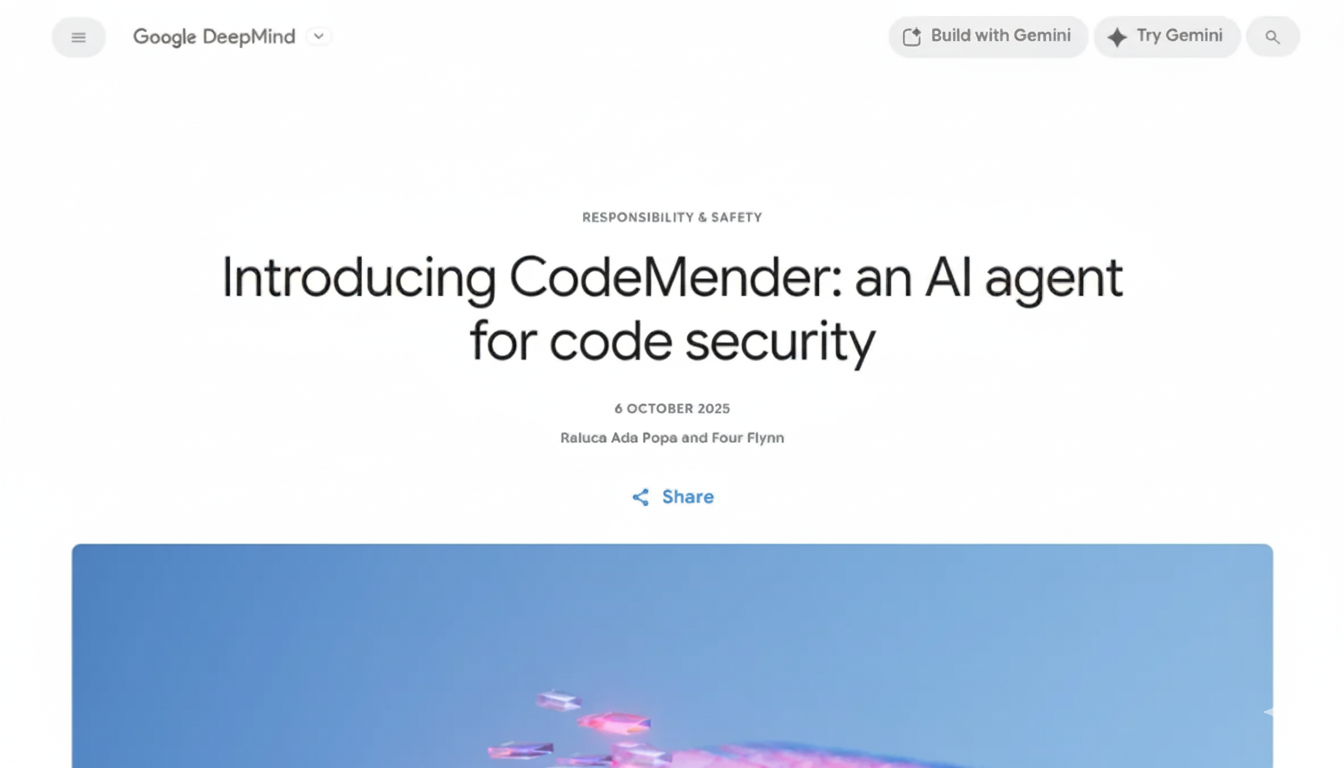
Google has just announced CodeMender, an autonomous AI agent built on Google’s Gemini models that identifies, analyzes, and patches software vulnerabilities, while also including a built-in review layer to vet its own patches (per The Tech Buzz). This marks a bold new step in “AI for defense” not just tools that assist developers, but AI that acts in the codebase with built-in oversight.
Below I explore the rise of AI in cybersecurity, the risks and trust challenges, and real use cases for CodeMender in open source and enterprises.
The Rise of AI in Cybersecurity: Defenders vs Attackers
Attackers are increasingly using AI to generate exploits, probe weaknesses, and accelerate attacks. Google itself states that AI can flip the balance defenders using AI tools like CodeMender might be able to act faster than adversaries (as described in Google’s “How We’re Securing the AI Frontier” blog).
Some prior AI-based tools include OSS-Fuzz (automated fuzzing) and BigSleep (vulnerability discovery). CodeMender aims to go further: autonomous remediation rather than just detection.
This arms race is intensifying. As attackers deploy AI to generate malware or zero-days, defenders must adopt AI agents that patch quickly and safely.
How CodeMender Works (Based on Public Reports)
While Google hasn’t released full technical paper yet, publicly available sources describe the architecture and pipeline as follows:
- Detection & Root Cause Analysis
- Uses Gemini models and program analysis (static + dynamic) to find vulnerabilities
- Combines fuzzing, symbolic reasoning, taint analysis, and “theorem provers” to uncover root issues
- Capable of proactive rewriting (i.e. removing classes of vulnerabilities, not just patching one instance)
- Patch Generation & Critique Layer
- Generates candidate patches
- A “critique” layer (automated peer review AI agents) analyzes those patches for correctness, security side effects, regressions, style, etc.
- Only patches that pass this review go for final human sign-off or auto deployment
- Human Oversight & Safe Deployment
- In early phases, all patches go through human review before being merged upstream
- As confidence grows, some well-validated patches might be applied automatically under controls
- Integration & Scaling
- CodeMender has already upstreamed ~72 fixes into open source projects (across millions of lines) as a proof of concept
- Applies both reactive (new vulnerability) and proactive (rewriting old code) strategies
This pipeline tries to balance autonomy with safety, reducing the chance of buggy or malicious patches being deployed.
Use Cases & Applicability
Open Source Projects
- Projects with large codebases (e.g. widely used libraries) could use CodeMender to offload parts of security maintenance
- Maintainers get AI-suggested patches, then review, speeding response time
Enterprise / Internal Codebases
- Internal systems with legacy code can benefit from automated patch suggestions, especially for known CVEs
- Shift developer time away from routine fixes to higher-value work
Vulnerability Bounty Programs / Security Teams
- Bug bounty programs could be augmented: CodeMender might pre-fix common issues before exposure
- Security teams could deploy the agent in staging or testing environments to vet code before production
Continuous Integration / DevSecOps
- Integrate CodeMender into CI/CD pipelines to scan every commit, propose patches, run critique, flag or automatically fix in dev branches
Risks, Trust & Oversight
While promising, autonomous patching comes with serious risks. Some key challenges:
- Patch correctness / regressions: A patch might break functionality, introduce new bugs, or degrade performance
- Security side effects / exploit introduction: A naive patch could open new attack surfaces
- Over-reliance / complacency: Developers may overtrust AI and skip critical manual review
- Agent compromise / poisoning: If an adversary poisons training data or the critique agent, malicious patches could get through
- Scope creep / agent escalation: Without boundaries, an agent might change more than intended
- Transparency & auditability: Every patch must be traceable, explainable, and reversible
Research in the domain of agent security warns of agent-based attacks that can lead to full system takeover if trust boundaries are weak.
Thus, wide adoption will depend on robust safeguards, oversight, and gradual rollout.
Summary & Key Takeaways
- CodeMender is Google’s newly announced autonomous AI agent to detect, analyze, and patch software vulnerabilities using Gemini models with built-in critique layers.
- It sits at the intersection of AI, software engineering, and security, pushing the role of AI from assistant to actor.
- Use cases range from open source to enterprise systems, security teams, and DevSecOps pipelines.
- But risks like buggy patches, agent compromise, overtruste, and governance must be addressed.
- In time, agents like CodeMender may shift the balance of power in cybersecurity defenders may augment human teams with automated agents that keep pace with AI-powered adversaries.
FAQs
What is CodeMender?
CodeMender is Google’s autonomous AI agent that uses Gemini models to detect, analyze, and patch software vulnerabilities, inserting a review layer to ensure safety.
How does CodeMender validate patches?
It uses automated “critique” agents to peer-review candidate patches, check correctness, prevent regressions or side effects, before human approval.
What types of codebases can benefit?
Open source libraries, large enterprise systems, legacy code, DevSecOps pipelines particularly where vulnerabilities accumulate faster than humans can patch.
What are the risks of letting an AI agent patch live code?
Risks include faulty patches, security side effects, overreliance, potential agent poisoning, scope creep, and lack of auditability.